
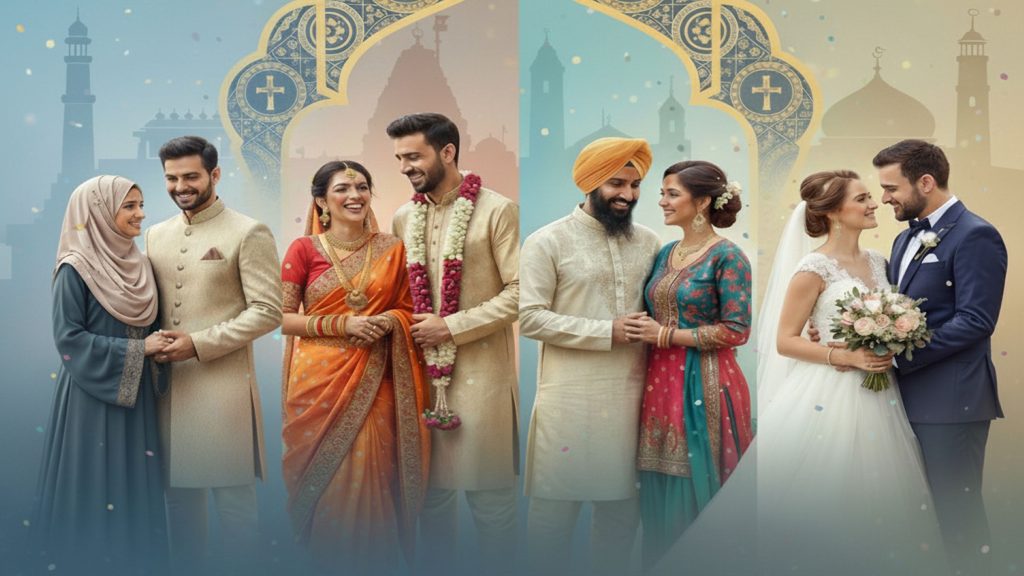
How Indian Families in Australia Are Finding Matches Across Communities
For generations, Indian families relied on local networks, community elders, and trusted relatives to find suitable matches for their children. But for the 700,000-strong Indian diaspora now calling Australia home, the matchmaking landscape has changed dramatically. Geography has expanded. Communities have diversified. And a new generation of Indian-Australians is navigating the marriage question with one foot in tradition and one foot in modernity.
The Distance Challenge — Why Traditional Methods No Longer Work
The classic Indian matchmaking model depended on proximity — aunties who knew everyone, community elders with access to family histories, and neighbourhood gatherings where eligible men and women would inevitably cross paths. In Australia, that model is simply not available to most Indian families.
A Punjabi family in Melbourne cannot rely on their village network in Amritsar. A Tamil Brahmin family in Sydney does not have access to the same temple community matchmaker they would have in Chennai. The geographical reality of diaspora life has made online matrimony platforms not a convenience, but a necessity.
Online matrimony is not replacing tradition — it is carrying tradition into a new
geography.
— Dr. Pam Nilan, Sociologist, University of Newcastle — Research on South Asian Diaspora Communities
Why All-Community Platforms Are the Future
Australia’s Indian diaspora is uniquely diverse compared to the motherland. In India, communities tend to cluster regionally — Punjabis in Punjab, Tamilians in Tamil Nadu, Bengalis in West Bengal. In Australia, a Sikh engineer from Brisbane and a Muslim doctor from Melbourne might work in the same hospital, attend the same community events, and ultimately find they are more compatible than anyone from their own village ever was.
This proximity is quietly transforming what Indian-Australian families look for in a match. Here is what the data and community feedback consistently shows:
• Faith remains the primary filter — the majority of Indian-Australian families still prefer a match within their own religion, but caste rigidity is softening significantly across generations.
• Values and education outrank geography — an educated, values-aligned partner from a different Indian state is now broadly preferred over a geographically familiar but incompatible one.
• Second-generation Indians have a decisive voice — unlike their parents who may have had arranged matches with minimal personal input, 25-40 year old Indian-Australians actively co-lead the search.
• The community is building itself online first — WhatsApp groups, Facebook communities, and matrimony platforms have replaced the role of the neighbourhood matchmaker in diaspora
life.
• Australia-based matches are increasingly preferred — practical concerns around visas, lifestyle compatibility, and cultural adjustment make local matches significantly more attractive.
The diaspora matrimony market is one of the fastest-growing segments in digital
matchmaking globally, driven by second-generation South Asians who demand
both cultural alignment and personal agency.
— IBIS World — Online Dating & Matchmaking Industry Report 2024
Step-by-Step: How Indian-Australian Families Are Finding Matches Today
Step 1 — Register on a Trusted All-Community Platform
The search begins online. Parents and their children create a detailed profile together, including religion, community, education, profession, family background, and a personal statement. Platforms like JodiMubarak.com that serve all communities — Hindu, Muslim, Sikh, Christian, Jain — are increasingly preferred because they reflect the inclusive reality of life in Australia.
Step 2 — Set Intelligent Filters
Country of residence (Australia) is typically the first filter. Religion follows. After that, filters by age, education level, profession, and family background help narrow the field. Most families start broad and refine as they get a feel for what is available.
Step 3 — Collaborative Family Browsing
In the majority of Indian-Australian families, profile browsing is a shared activity. Parents and children sit together — sometimes over a weekend meal reviewing profiles and shortlisting candidates.
This collaborative approach is one of the most powerful aspects of the matrimony tradition: it distributes the emotional weight of the search across the family.
Step 4 — First Digital Contact
Once a profile is shortlisted, contact is initiated through the platform’s messaging system. Many families prefer a formal expression of interest first. Video calls follow — often within 2-3 exchanges — so both families can get a proper sense of each other before exchanging phone numbers.
Step 5 — Family Meeting
If video calls go well, an in-person meeting is arranged. In Australia, this is typically a lunch or dinner — either at a restaurant or one family’s home. Both families attend. The atmosphere is deliberately relaxed but the occasion is understood to be significant.
Step 6 — Decision Period
After the meeting, both families take time to reflect. If interest is mutual, a more regular series of one-on-one conversations between the two individuals follows. Most families allow 2-4 months of this phase before expecting a decision either way.
The JodiMubarak Difference — Why All Communities Matter
Most matrimony platforms were built for a single community —Shaadi.com skews Hindu, Muslima.com serves Muslims exclusively. JodiMubarak.com was built from the ground up to serve every Indian community under one roof. This matters enormously in Australia, where the Indian community does not split neatly along religious lines in daily life.
• A Tamil Hindu family whose son works alongside a Tamil Christian colleague every day should be able to explore that connection on the same platform.
• A Punjabi Sikh family whose daughter grew up with Muslim neighbours and shares their values should not have to join three different platforms to explore their options.
• An Anglo-Indian Christian family in Melbourne should not be an afterthought on a platform designed for North Indian Hindus.
Inclusive platforms that remove artificial community barriers while preserving
individual faith preferences represent the next evolution of the matrimony
industry.
— Priya Malhotra, Digital Matrimony Analyst — South Asian Marriage Trends Report 2023
Quick Tips for Indian Families Starting Their Search in Australia
✓ Complete 100% of your profile — incomplete profiles receive 60% fewer responses.
✓ Upload at least 3 recent, clear photographs — profiles with photos get 8x more interest.
✓ Write a genuine personal statement — copy-paste descriptions are immediately obvious and ignored.
✓ Be upfront about your location preference — Australia-based vs open to India-based candidates.
✓ Involve both parents and the individual in reviewing profiles — alignment from the start prevents conflict later.
✓ Use verified-profile platforms only — scam profiles are unfortunately common on unmoderated sites.
A New Chapter in an Ancient Tradition
Matchmaking in the Indian tradition has always been about far more than two individuals — it has been about families, communities, shared values, and a collective vision for the future. In Australia, that tradition is not fading. It is adapting. Technology has not replaced the human heart of Indian matchmaking — it has simply given it a wider reach, a smarter filter, and a global address book. Whether your family has been in Australia for one year or twenty, the search for a meaningful, compatible match is as important — and as possible — as it has ever been.
Indians in Australia (ABS Census 2021)
Use online platforms for matrimony
search
Faster match rate on all-community
platforms
Find Your Match Across All Communities — Register Free Today
Join thousands of Indian families across Australia and India who trust JodiMubarak
www.jodimubarak.com
 Jodi Mubarak and its logo are registered trademark.